A microscopic image of onion cells appears under a microscope in a biology textbook print




Framed Prints From Alamy
This artwork is available as
Framed Print of Advanced biology. Biology; Physiology; Reproduction
Advanced biology. Biology; Physiology; Reproduction. PROBLEMS 25 V. Turn on the high power. Again draw the letter, or as much as you can see of it, as large as it appears. Measure your drawing with your- ruler and see how many times the high power appears to magnify the letter. VI. Have your teacher tell you how much the microscope really enlarges the object with low and high power. Cmdion. Always find your object with the low-power objective, then turn on the high power. If you lose your high- power focus, go back to low power and refocus. Problem. How do onion cells ap- pear when viewed th. Advanced biology. Biology; Physiology; Reproduction. PROBLEMS 25 V. Turn on the high power. Again draw the letter, or as much as you can see of it, as large as it appears. Measure your drawing with your- ruler and see how many times the high power appears to magnify the letter. VI. Have your teacher tell you how much the microscope really enlarges the object with low and high power. Cmdion. Always find your object with the low-power objective, then turn on the high power. If you lose your high- power focus, go back to low power and refocus. Problem. How do onion cells ap- pear when viewed through the micro- scope f Cut an onion into halves or quarters. Peel off one of the scalelike leaves. By means of a pair of forceps or knife strip the thin tissue from the inside of the scale. Mount a part of it on a glass slide in a drop of water and cover with a cover glass. Be sure to flatten your specimen before covering it. View the material under the microscope. Then remove cover glass, and stain the material by adding a small drop of dilute iodine solution. Again cover. Ob- serve wdth low power, then high power. I. The little divisions that make up the onion membrane are called cells. A. The boundary of each cell is the cell ivall. The cells of the onion tissue often show B. Describe the color and shape the heavy, woody walls and the large vacuoles of these cells ^ *^^* ^'?^ characteristic of most plant cells. II. Observe the position of the granular and clear areas. The granular areas make up the living part of the cell and are composed of a material called cytoplasm. The clear areas are the vacuoles or fluid-filled spaces in the cytoplasm. III. Find a small dense area somewhere in the cytoplasm. This is the nucleus. A. Each nucleus has two disklike structures called nucleoli. Try to identifv a nucleolus in a nucleus. WH. FITZ. AD. BIO.—3. Please note that these images are extracted from scanned page images that may have been digitally enhanced for readability - colora. © Library Book Collection
Artwork Licensed From Alamy
Your chosen combination is quickly and professionally made to order - Shipping & Delivery Details
If you are not entirely happy with your items, simply return them to us within 30 days for a replacement or full refund - 30 Day Returns
Media ID 50835534
Premium A1 (A2 Poster)
Ready to Hang Contemporary Framed Prints adds style, protection, and a polished touch to your space - effortlessly.
Your artwork will be printed as shown in the preview. To adjust please select Print Options under the Buy button
Premium Paradise Wooden Range A1 Premium Poster Frame (86x62cm) with A2 Poster (59x42cm) and mounted behind a white matt board to make your photo really stand out. FSC Certified and Rainforest Alliance Certified for environmental, social, and economic sustainably. High transparency tempered glass window with a smooth finished frame. Great for filling empty walls, decorating blank spaces, or creating eye-catching gallery walls. Frames arrive ready to hang. Sent with secure, protective packaging. Smooth wooden veneer mimics the real wood look and feel with ultra-durable scratch resistance tempered glass. Note: measurements provided are estimated outer dimensions, which include both the image and the frame. While we aim to keep sizing consistent, exact dimensions may vary slightly due to differences in print size or production requirements, which may result in a variation in the overall size (up to approximately 2.5cm (1"))
These are individually made so all sizes are approximate
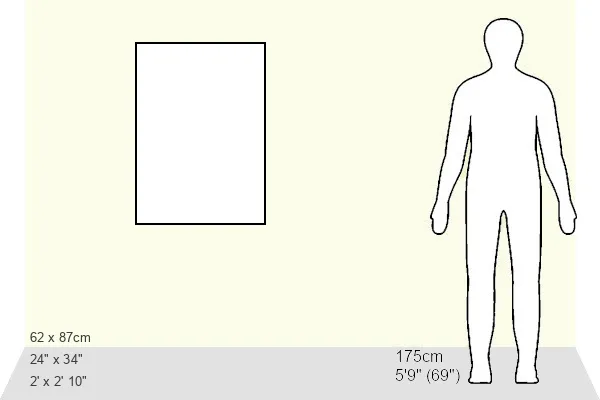
Estimated Image Size (if not cropped) is 41.4cm x 58.8cm (16.3" x 23.1")
Estimated Product Size is 62cm x 86.6cm (24.4" x 34.1")